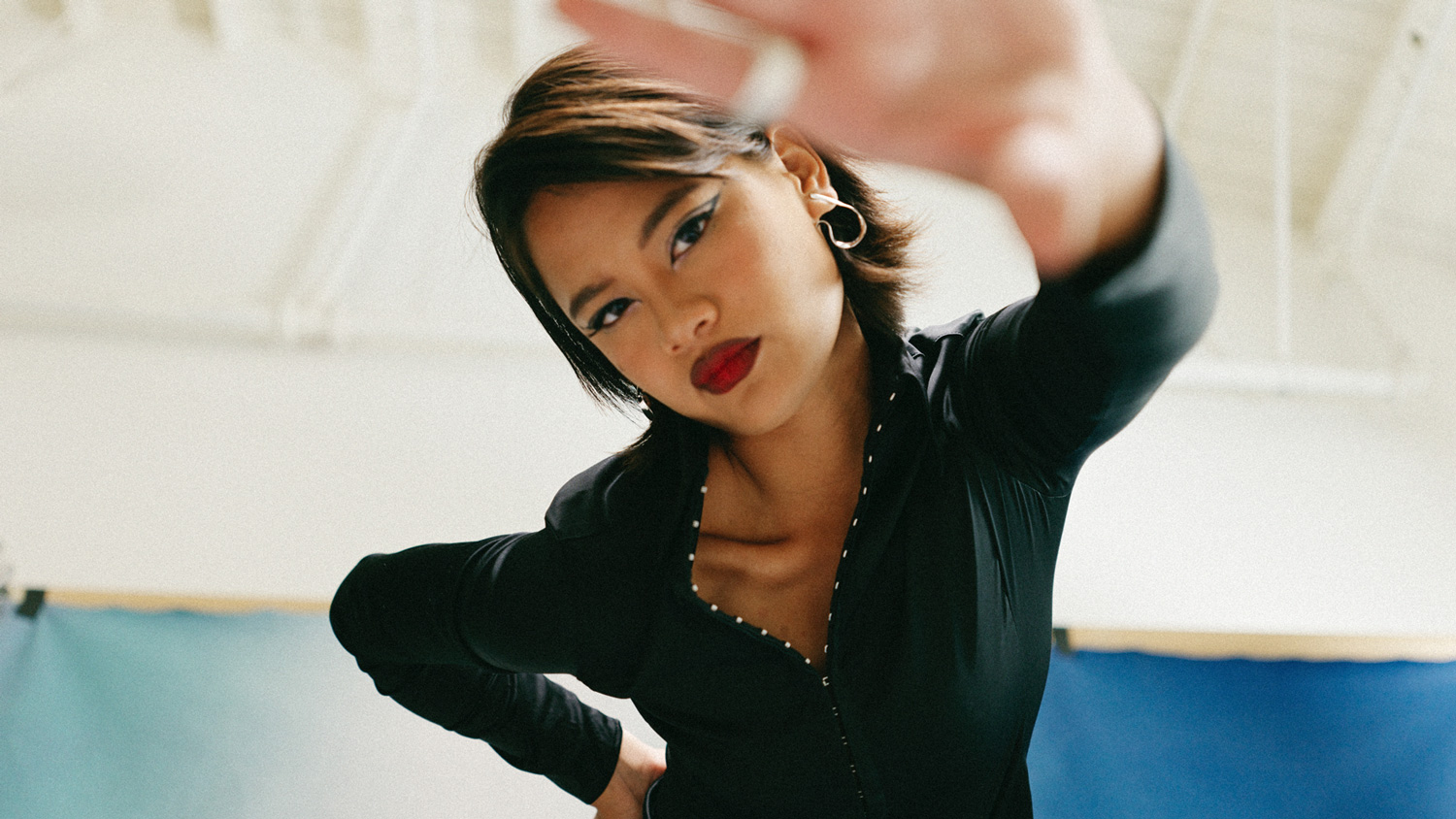
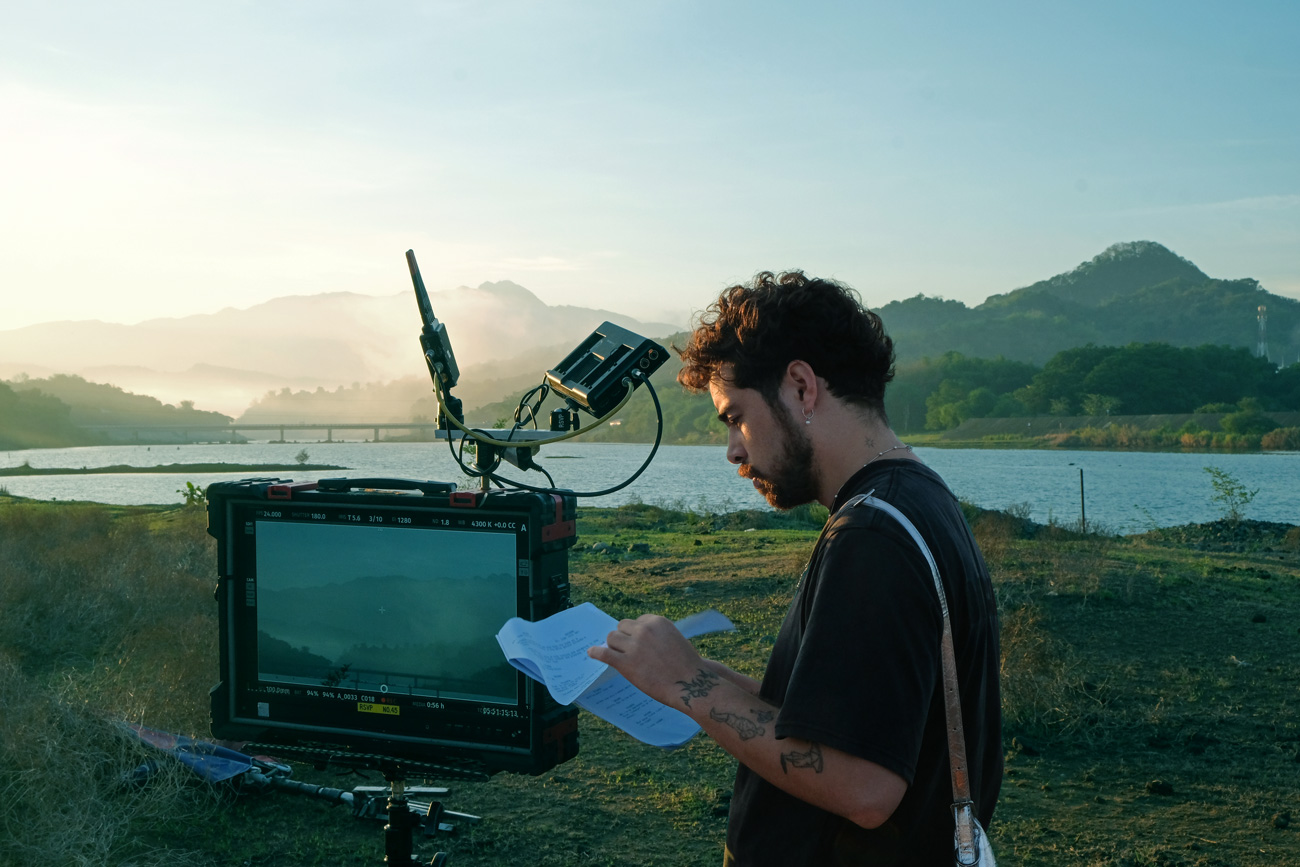
James J Robinson is a Filipino/Australian photographer and filmmaker. His images have taken him around the world and have have kept him in constant demand; Robinson’s work blends vivid imagery from different worlds, juxtaposing the glamour of Hollywood with the grime, pulp, and surrealism of experimental grindhouse cinema. His clients include illustrious names such as Gentle Monster, Prada, Bad Bunny, and Megan Thee Stallion.
Stepping from one lens to another, Robinson decided a few years ago to enter the world of filmmaking. While most set their expectations for a ‘James J Robinson’ feature by his photography work, Robinson challenged himself to make something far more contemplative and ethereal. The result is his stunning debut, ‘First Light’. The film follows Sister Yolanda, a middle-aged Catholic nun who is at the centre of an institutional conspiracy and at a spiritual crossroads. ‘First Light’ draws from Robinson’s complex relationship with Catholicism, queerness, and women who have played defining roles in his life. The film tells a layered story that chooses optimism in a world shrouded in uncertainty.
We caught up with Robinson days after the screening of ‘First Light’ at this year’s Sydney Film Festival.

So firstly, congratulations on the screening of ‘First Light’ at the Sydney Film Festival. What was it like watching the film with so many family and friends in attendance?
Really good. I mean, we’ve obviously gone around the world to different festivals. But doing it in Sydney, at a screening where I could have so many close friends and the film community there, was really nice. We obviously did our world premiere in Melbourne, where we had all my friends and family there, which was the best. So to do the same thing again in Sydney a few months after having taken it a little bit around the world was really special.
Also, I feel like friends pick up on things that random audience members wouldn’t because they know my sensibility and my taste. They can pick out things that normal movie-goers wouldn’t recognise. That was lovely.

Was the screening at the State Theatre?
Yes…Wait, no. We did the Sydney Opera House and then the Dendy in Newtown.
Even better, our most iconic icon.
Screening at the Sydney Opera House is really special. We always get the embassy involved whenever we’re screening anywhere. They were so happy to have photos of Ruby and all of us in front of the Sydney Opera House. It was awesome.
Icons and icons.
Yes. Literally (laughs).
Most people reading this interview would know you from your extensive photography career, where you’ve shot everyone who’s anyone. Was there any pressure in thinking about people’s expectations of what your feature film debut would be like?
It was something I thought about a lot. People have an expectation of not only what type of film I would make, but also the kind of people that I would cast. When I was first pitching the film, the idea of having someone well-known in it came up because I had access to celebrities who might’ve been able to work on it. But to me, I had to do something right for the story.

I know that casting a celebrity or someone recognisable outside of the Philippines in a film like this would take the audience out of the story. This is why I love watching foreign language films where I don’t know the cast. To me, the actor completely embodies the character. I knew I wanted the same experience for my first film. I wanted the challenge of getting a film off the ground without relying on my photography career and the doors it would open. I was glad that I made ‘First Light’ on my own terms.
Aside from casting, I wrote a film when I was 26 or 27. Thematically, people had an idea of what the film might be about. I feel that at that age, people make high school films or something centred on teenagers. I think the general narrative of a character coming of age can happen at any point in life. That’s why I love the character of Sister Yolanda, because even at her age, she’s still someone who’s learning and questioning things. She isn’t set in her ways.

Oh, we’re going to get into that performance and Ruby in a bit.
Oh yeah.
If I read this correctly, your auntie was in the running to be the pope at the most recent conclave?
So this is a bit random (laughs). It’s my grandmother’s second cousin, Cardinal Tagle, who was the frontrunner for a period to be the next pope. Ultimately, he wasn’t selected, which I’m okay with, because the new pope seems really great (laughs). I don’t know if you remember this, but for a moment, there were so many memes all over TikTok about what a Filipino pope would look like. Everyone was singing karaoke at the Vatican (laughs). There was a chance he could’ve become the pope, but alas, he’s still a cardinal, which is great.
At that time I lived for those memes. It reminds me of how everyone’s making content of New Yorker’s destroying the city because of the Knicks.
Yeah, it’s the same, just with Filipinos (laughs).
Talking about the themes, why did you want to explore religion and spirituality in your debut feature film?
I think that is where I was at in my life during that period. I first started writing it in my late 20s; I was really starting to understand to what degree being raised Catholic had instilled a lot of shame in me being gay. It was the main thing I was working on in therapy at the time. I was in a long-term relationship, and a lot of those traumas were starting to come up and present themselves in different ways. Also, the religious discrimination bill was being discussed in the Australian Parliament, which Scott Morrison was trying to bring in. That’s when a lot of those feelings that were coming up for me in therapy were then also being brought up on a national scale.
I was trying to question the degree to which religion should be interwoven with politics. A lot of people say the film is very mature and complex. However, I think the actual themes I was trying to attack are very common experiences for any queer person growing up in a catholic context.

You brought up Ruby Ruiz before who gives such a beautiful, tender, performance as Sister Yolanda. I was looking at her IMDb, and she has several credits as a producer and crew member, and over 100 as an actor.
Yes. It’s crazy.
As a two-part question. What was it like creating this character, and what was it like having such a seasoned actor at the top of the call sheet?
I had written different versions of the script. There’s a version where the nun was younger, which split off into a subplot with Sister Eileen, and others where she was even older. To me, her character really represents a lot of the women my mother’s age and the aunties who raised me.
I wanted to write a character who is very strong in her desire to help others. We often mistake someone who is kind and helps others as almost being passive and weak. Whereas, instead, I think it’s actually quite radical to be optimistic and care for other people. It’s the harder choice. It’s definitely a thing in our generation, you know? It’s like pessimism is cool and that’s how you show off your intellect. You live in disbelief; you’re disconnected and think you know how something like capitalism works. But to me, there’s an extra level to it. You understand that the systems we have in place don’t work. However, you make the decision to still believe in something greater. That’s so powerful. I wanted to capture a character that would do that. The women in my life who raised me are like that. Sister Yolanda distils and captures on screen the strength in quiet power.

Working with Ruby was amazing for me as a first-time director. She coaches many young actors in the Philippines who are transitioning from platforms like Instagram to the big screen. For me, coming from photography, leading big sets isn’t a problem. I’ve done it for so long that I feel little to no anxiety about it. But in film, the part that’s probably most important is directing actors through an entire narrative. That’s something I didn’t have much experience in. So, having Ruby as the first lead actor I’ve ever directed in something long-form is just such a dream. I could be very candid with her, and I learnt so much.
As you mentioned, in addition to being an actor, she actually started off as a director’s assistant. She worked in production and even worked with my producer Jane before on ads. She only started stepping in front of the camera because someone wanted to see her there. She slowly started taking it more seriously, making her way to theatre. Working with someone so seasoned in front of and behind the camera, I think, was really special. She really understands the whole filmmaking process, and she could guide my hand in directing as much as I could guide her.

Touching upon something you just said, we live in an information society where we can be quite pessimistic and cynical. I was really touched by the scene with Angelo (SPOILER), who asked, “what’s going to happen to me?” While she can’t answer him, she doesn’t cower from that moment. I thought it was such a beautiful thing.
Thank you. That was a hard one to write because I wanted Yolanda to be saying, “it’s going to be okay”, as Angelo’s on his deathbed. But I think she is too honest a character to say that. She’s someone who’s been raised with a particular dogmatic belief. While she can give him comfort, she doesn’t know the eternal questions of, “where do you go?” Later in the film, she explains her understanding of heaven. Distilling that moment and fear is the control religion can have over you. It can dictate the existence of the universe and whether you go to heaven or hell. That then becomes such a powerful control mechanism over your actions as a person. It can be useful in some ways, but as a general tool for humanity, I’m not sure it’s the most effective or that it leads to the most good. If anything, I think it leads to the most spiritual bypassing.

From what I’ve read, the making of this film could have been a film unto itself.
Yes, absolutely.
Shades of Francis Ford Coppola and Apocalypse Now.
Yes (laughs).
Can you talk about some of those challenges in making this film?
I mean, we’re really blessed in a lot of ways. Coming from Australia, we’re so used to doing a ‘Welcome to Country’ before an event. It’s really gotten me in the mindset and sensibility of thinking about where I’m shooting. One of the first things I asked my producers and everyone to do was ask permission to film on the land before we started production. It was important to me because we’re telling a decolonial story. We also consulted with indigenous groups up in the mountains. We held ceremonies, essentially to ask permission to be on the land. At one of our first ceremonies, there was a sign that said we were really blessed to be there. The spirits and ancestors were not just happy, but called us to be there.

In general, shooting was quite smooth. It was sunny on the days we needed sun and rainy on the days we needed rain. Everything ended up flowing the right way. Yes, there was a possession on set, which was very eye-opening, like, obviously. When I told this story to people in Australia, they were sceptical and asked, “Did she really do that?” I can’t explain it any more than what I saw with my own eyes.
I don’t think it’s specifically part of Filipino culture. Every culture around the world has an interaction of something similar happening. Witnessing a person become possessed and then be okay after an exorcism was scary, but everything ended up being fine. We had an understanding of what happened on a metaphysical level, which wasn’t terrifying, like we weren’t being haunted by anything malicious. It was just an eye-opening experience for a lot of the crew and me.

As a last question, what do you hope people take away from the film?
I’ve had to disentangle myself from that question. That’s something that I asked myself when I first started writing the script. My relationship to creativity has changed since making this film. A film takes years to make, while other projects like photography can be shot, delivered, and out within a week.
For me, I kind of realised at a certain point that I can’t control how the audience is ever going to take something. I can propose ideas to them. But if my reason for making a film is to get something out of an audience, it’d just be running around in circles. It’s something I can’t control. Thinking about the audience too much would drive me crazy. I’m trying to tackle something deeper and much more personal in understanding my place in the universe and in humanity. I ask myself what I want to offer as a human. What are my morals? I’m always trying to refine myself as a person.

‘First Light’ is definitely my process of understanding Catholicism, queerness, and Filipino heritage. I would love for audiences to question how politics can become intertwined with religion. There’s a danger in letting those two things become conflated.
Ultimately, that is the kind of question I was asking myself at the time of writing and filming. All I can really do as an artist is express myself. There’s a saying that goes, “An artist dies once the artwork is released” I very much feel that way. Many people have had different responses to the film. In the Philippines, people have picked up on certain things, while in Australia they have responded to different things. I very deliberately had restraint as a director to allow those different levels of interpretation. However, there was one time in Rotterdam when an old lady came up to my producers and me at a Q&A and said that the film wasn’t about decolonisation (laughs). I was like, “Well, it’s a pretty major theme” (laughs). You can’t take away the context of Spain colonising the Philippines out of the film. That was the only time I had to say, “Hey, that’s wrong” (laughs). I’ve done something right if people have different interpretations of the film.

This would be like my subway hot take. I love and hate a film festival Q&A.
Yeah, period (laughs). The way they do it in Melbourne is you have to send your question on a phone and then the moderator can ask the questions they want. In Sydney, there were some questions where I was cringing a bit.
Whenever I go to a film festival Q&A in Sydney, there’s always an old, kind of kooky white person who asks a question. In my mind, they’re either going to cook or say the craziest thing ever (laughs).
They’re going to say the best freaking question, the most irrelevant one, or they’re not even going to have a question.
They’re just going to make a statement like a kindergartener.
Literally (laughs).
Congratulations on such a beautiful film.
Thank you so much for taking the time. It means a lot. It’s been so much fun doing press, and I’m just so excited to bring it to Australian theatres. The very idea of having a film in Tagalog in Filipino cinemas is already so exciting for me. No matter how the film does, I’m just so happy that it got made.

Thanks to James for taking the time to chat. You can follow him @james.pdf and find his work here. Also I want to give a special mention to the good people at Nixco for making this happen.
‘First Light’ is out this Thursday (9/7) in cinemas across Australia. Make sure to get a ticket!