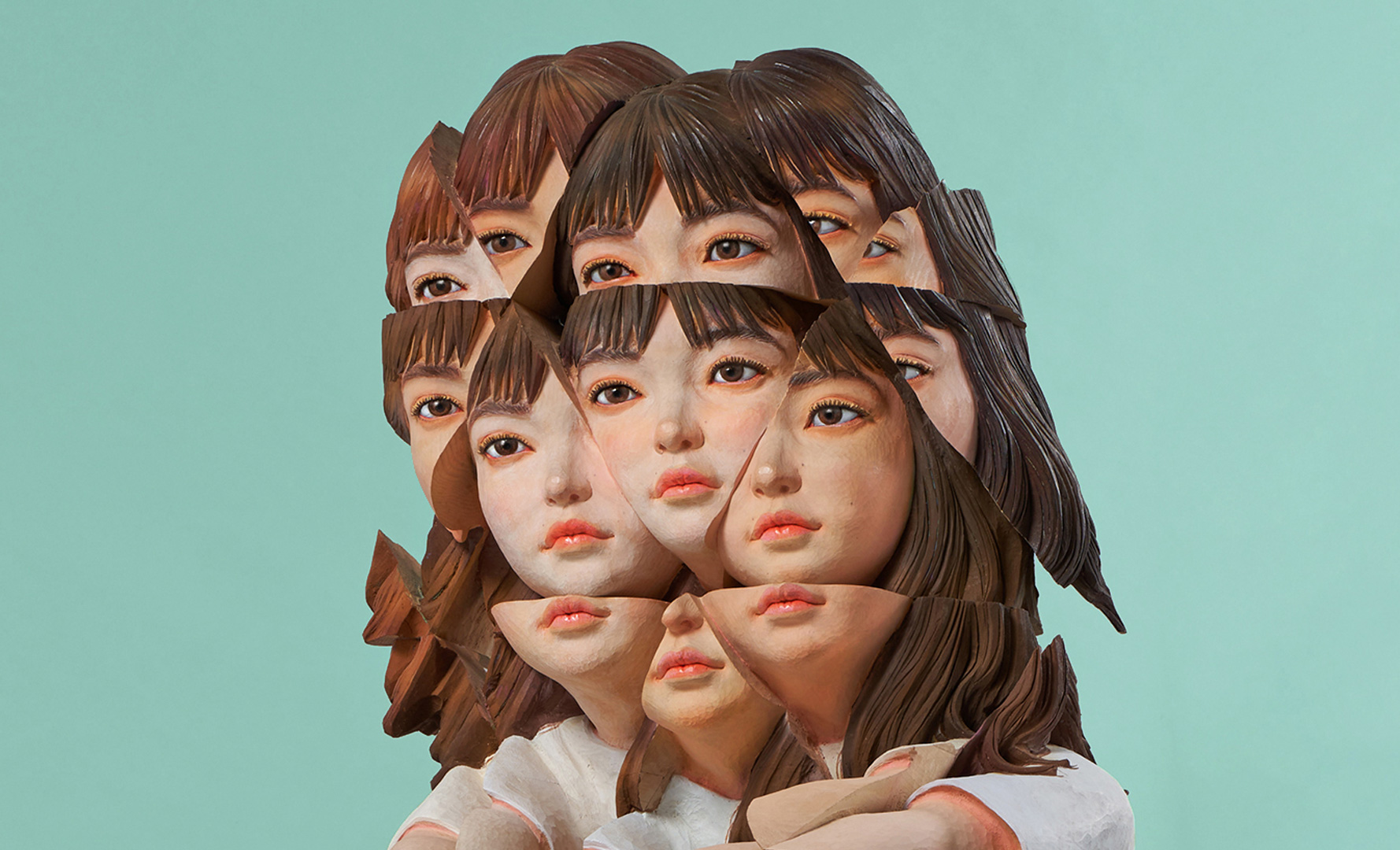
Yoskitoshi Kanemaki is a Japanese artist renowned for his surrealist sculptures. For nearly three decades, he has devoted himself to a practice that draws multiple identities from a single form. In Kanemaki’s hands, a piece of timber becomes something that exists in the depths of the uncanny valley. In his works, figures multiply and splinter, as if fighting to free themselves from their stationary structures.
Over his career, he has participated in dozens of group shows and more than seventeen solo exhibitions. In 2026, he held his latest exhibition, ‘Emergence Entity ’, at the hugely popular PARCO MUSEUM in Tokyo.

©Yoshitoshi Kanemaki | FUMA Contemporary Tokyo | BUNKYO ART
What drew you to working primarily with timber?
The direct reason I began working with wood was that I chose wood carving as my major while studying sculpture at Tama Art University.
I also grew up in an environment surrounded by trees, so I believe that this gave me a natural familiarity and affinity with wood from an early age.
As I learned more deeply about wood as a material, I began to feel that trees are very close to human beings. They need water, nutrients, and sunlight to grow; they breathe, and they can also become sick. In this sense, I came to see wood as a living material that has many things in common with us. Since then, I have believed that wood is the most suitable material for expressing the human figure through sculpture.

©Yoshitoshi Kanemaki | FUMA Contemporary Tokyo | BUNKYO ART
Does your process start with meticulous planning of what you’re going to sculpt, or is it more intuitive?
At the beginning of each project, I carefully develop the concept and decide how I want to express it.
Of course, because I work with natural wood, there are times when I need to change direction unexpectedly. Sometimes, unexpected elements or accidents also bring the work to life. However, in general, I work with a clear image of the final form in mind and move forward toward it.

©Yoshitoshi Kanemaki | FUMA Contemporary Tokyo | BUNKYO ART
Each of your sculptures blur the linear concepts of both form and time. What inspires you to challenge these ideas?
We tend to think of the time we live in as always moving forward in one direction. But have you ever experienced emotions that do not simply pass by, but instead move back and forth, going around the same place again and again without reaching an answer?
When I wanted to express these complex emotions through sculpture, I arrived at the idea of introducing distortion and repetition into form, time, and space.
While always asking myself the question, “What does it mean to be human?”, I continue to search for new ways of expressing these ideas.

©Yoshitoshi Kanemaki | FUMA Contemporary Tokyo | BUNKYO ART
In the past, you’ve talked about how you’re interested in exploring how we experience contradictory emotions from day to day, often while being unaware that it’s happening. In this sense, do you see your work being more relevant now than ever?
I think it is fair to say that all of us living in this era are constantly living with contradictions. From personal problems in our everyday lives to the international and social issues facing the world, there seem to be contradictions everywhere.
My work mainly focuses on personal emotions, but when we broaden the way we interpret these emotions, they inevitably connect to the various issues of the world we live in today.
In that sense, I believe my work can speak to the hearts of many people living in the present day, regardless of their age, gender, or country.

©Yoshitoshi Kanemaki | FUMA Contemporary Tokyo | BUNKYO ART
Having a career that has spanned three decades, do you feel any sense of slowing down anytime soon?
Many years have passed almost in the blink of an eye since I began making sculptures, despite all the twists and turns along the way.
However, I do not believe that an artist’s career should be measured by a fixed period of time. I believe it is something that is built throughout one’s entire life.
I want to continue creating while staying aware of the times we live in and slowing down as little as possible. At the same time, I want to keep asking myself the fundamental question: “Why sculpture, now?” I hope to continue pursuing my artistic practice with that question in mind.
Thanks to Yoshitoshi Kanemaki for taking the time to chat. Make sure follow at @kanemaki_yoshitoshi. Special thanks to FUMA Contemporary Tokyo /BUNKYO Art for making this happen and providing all the images.