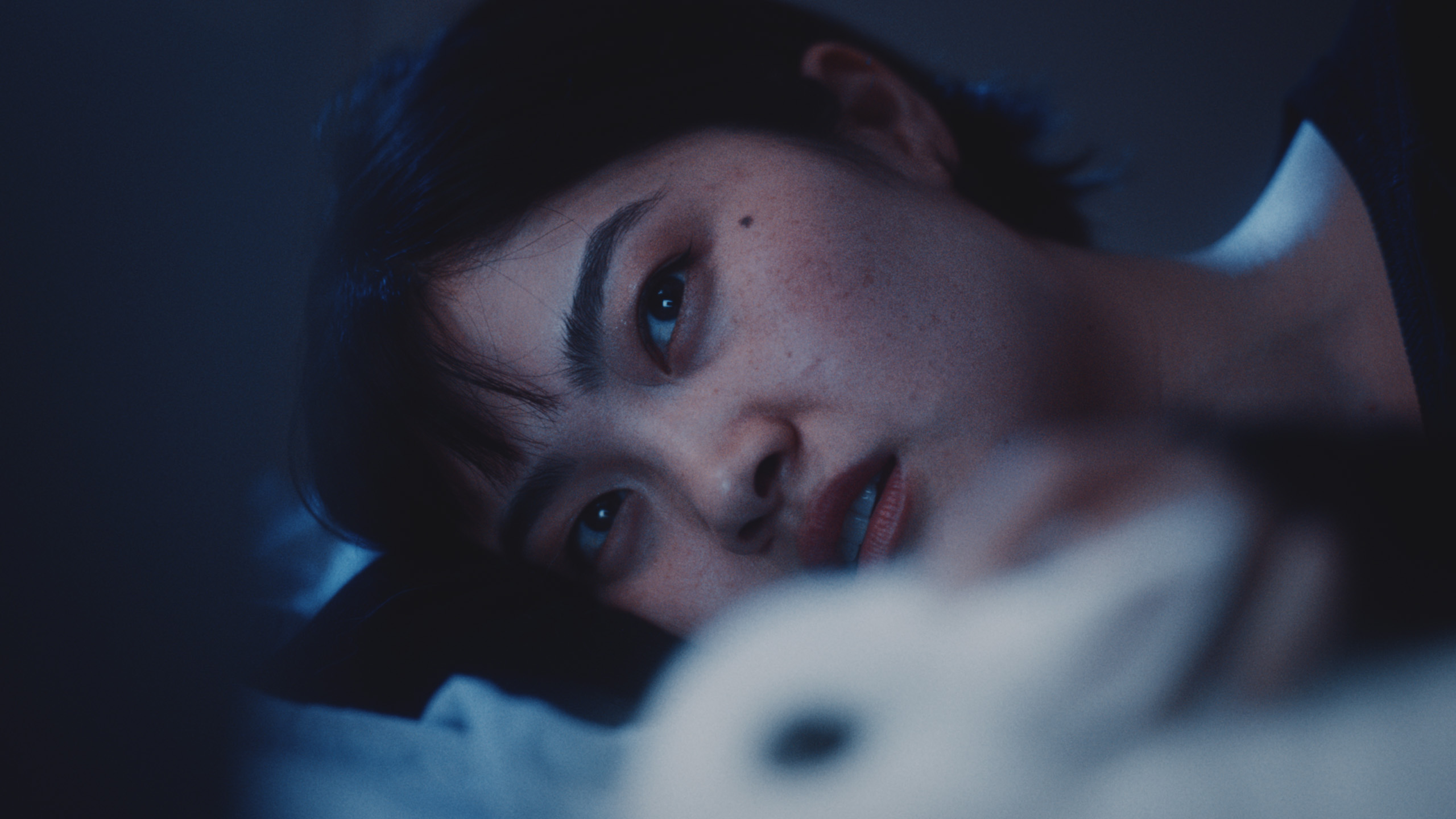
It’s the dead of night. A single portal illuminates in the darkness. Rebecca sits on her bed, face washed in a pale blue from the light of her laptop. She charms an audience of faceless usernames. The live chat unfurls into an endless stream of fawning and thirsty comments as they send credits and gifts. She thanks them and lets them know when she’ll be camming again.
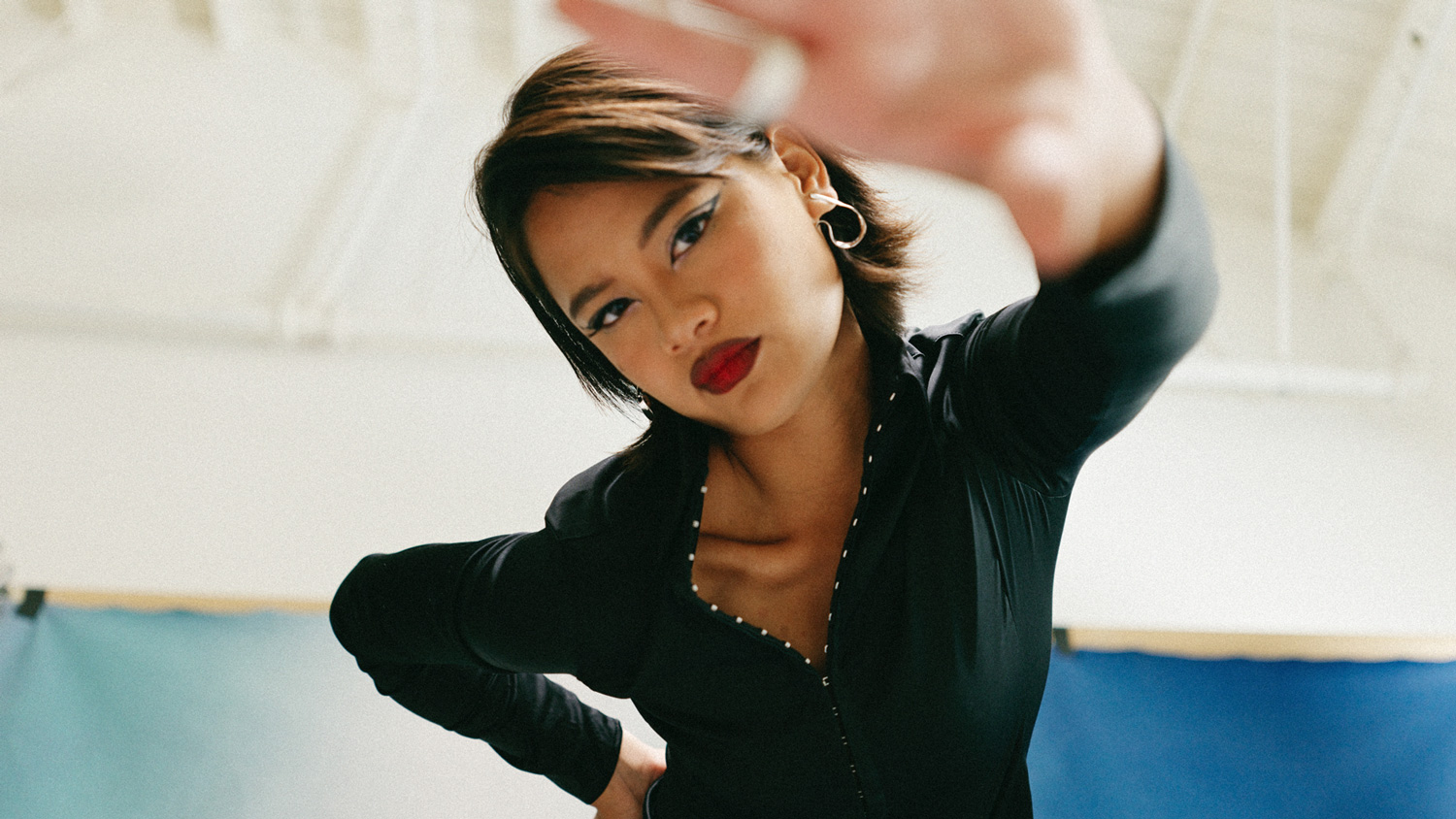
My experience with Rebecca also involved a screen but was very, VERY different. The time was 7:00am. Wearing my trusty fleece jacket that had accompanied me through two bouts of Covid and a Mets cap that barely hid my bed hair, I sat staring at a pixelated version of my puffy face. I was waiting to speak with the creator of ‘Bunnylovr’ and the actor behind Rebecca, Katarina Zhu. All of a sudden, a chat window popped up. Zhu casually greeted me before repeatedly apologising for how early it was. I’d only seen her as Rebecca whose languid demeanour made it feel as though she was someone who floated through life in a constant haze. In contrast, Zhu was articulate, attentive, and effortlessly likeable. It was easy to see how she amassed an all-star line-up on and off the camera with her enthusiasm and gregarious nature. She was someone you’d want to back.
I learnt that after graduating from NYU’s Tisch School of the Arts, Zhu spent the following years working across the film industry. However, she hardly saw opportunities for nuanced portrayals of Asian-American women that she eagerly sought. Zhu decided to make her own opportunity by writing, directing and starring in her own film, ‘Bunnylovr’.
‘Bunnylovr’ follows our twenty-something-year-old protagonist as she navigates life in New York City. She spends her days having sex with her ex, trying to connect with her estranged father, and flaking on her sole friend. With Rebecca’s job as a personal assistant hanging by a thread, she moonlights as a cam girl. During one of her streams, a client offers to send her a small white bunny. What follows is a spiral into the depths of dissociation, isolation, and toxic relationships.
Firstly, congratulations on ‘Bunnylover’! What has it been like to have people see the film at festivals throughout the year?
Thank you so much. It’s been amazing to share it with so many different people. In July, I was in Paris for the Champs-Élysées, Valencia for Cinema Jove, and then in Munich. It’s been amazing to share it with the world and see how it resonates with different audiences. I’ve also enjoyed sharing it with smaller, regional festivals, such as the one I attended in Philly this past Sunday.
I remember at the rooftop film screening in New York, there was an older man. He must have been like 70 or something. He came up to me and was like, “I haven’t written in such a long time but after seeing your film I’m inspired to write again.” It’s really always nice to be surprised by who and where the film resonates.
That’s the perfect segue into my next question. I’m so interested in the process of writing a film. When you approached it, did you go with the ‘Save The Cat’ route, or did you reject it and draw from your own life experiences and acting studies?
I studied acting at NYU, and began auditioning professionally in my sophomore year. I was reading a bunch of scripts. Many of them were not very good but I got a general sense of story structure. I was absorbing so much without even really being aware of it. I know of ‘Save The Cat’ but I’ve never read it. My way of learning was just by reading scripts and watching movies.
Even to this day, I still watch and read scripts of my favourite movies through a technical lens. I’ll plot out when the film starts to shift and what the character arcs are. And then, obviously, drawing a lot on my own experiences. All of this combined helped me figure out how to write this feature.

I’d like to discuss the character of Rebecca. When I was researching the film, you said it wasn’t your intention to play her, but then at some point, you couldn’t give it up.
I’m going to contradict myself (laughs). Somewhere in the back of my mind, I always knew that I wanted to play the lead. A big part of why I came to writing and directing in the first place was because I was auditioning a lot and not getting anything. I didn’t really see myself in any of the roles I was going for.
I do feel like this script came from a place of necessity. I wanted to write a role for myself and see myself in a part that really resonated with me, one that felt authentic and nuanced. There may have been a fear of saying it out loud in the early stages. A part of it was tricking myself into believing that it was meant for someone else, so I could write the most honest, authentic version of the script. If I were playing the lead from the jump, there may have been things that I held back on or had fears of doing.
When you were writing Rebecca, did you consider how challenging it would be to play her or just focusing on writing the most satisfying character?
It was definitely the latter. I asked myself what a fully fleshed, well-rounded character looked like. And then, I had to step up. I worked with an acting coach for a couple of weeks and prepared accordingly.
When I was watching the film, one of the things I loved about Rebecca is how relatably frustrating she is. We’ve all known a Rebecca. I’m sure in some situations, I’ve been a Rebecca. What was it like trying to find the right balance between a character that’s simultaneously closed off and vulnerable?
I don’t know. It’s funny writing a character that’s very close to me in many ways, and then having other people take it and reflect back to me. I didn’t realise that she was so closed off. I wasn’t so conscious about the balance of being closed off and vulnerable. I was writing the most honest and authentic version of this character possible.
Sorry I feel like that’s like a non-answer (laughs).
It must be strange. I’m not sure if it’s entirely fair to say the character’s frustrating.
It’s totally fair. I remember early on in one of the feedback screenings, someone left a comment that was like, “I just want to shake her.” Something really important to me was writing a character who can be passive because they lack a sense of agency. That is something that I’ve always been interested in. It’s challenging to make a passive character engaging. I heard some feedback or criticisms saying she’s very hard to read, or there’s a veil that makes it challenging to connect with her because she sort of dissociated.
To go back to what we were talking about before. I listened to an audiobook of ‘Save The Cat’. It’s got a lot of rules of what a successful character and story should be.
Right, right.
I just feel like watching Rebecca, she’s real to life. As I’m getting older, I just want to look inside people’s heads because I can’t read what’s going on. Maybe I give off that vibe too. Which is one of the worst case scenarios as a journalist (laughs).
Totally. You just have a poker face, completely unreadable (laughs).
You’d have no idea If I enjoyed the film or not (laughs).
There’s definitely a part of me that is weary of falling into archetypes and tropes.
I want to also talk about the look of the film. It’s got an almost 1970s kind of gritty aesthetic. I love the way the reds and blues look, especially in the scenes where Rebecca’s streaming. How did you and cinematographer Daisy Zhou decide on the look of the film?
From the beginning one thing we talked about was wanting Rebecca’s room to feel like a cocoon. We wanted her room to feel like her safe place. Once she’s out in the world of New York City, it’s more jarring and violent. I think that’s where you’re getting the 70s grime and grit from.
The first zoom that Daisy and I had, we immediately hit on one of our shared favourite DP’s Hélène Louvart. We were referencing her work a lot in terms of camera movements and stuff like that. I feel like I’m not the best with colour. What I do have is a lot of clarity on what I want the emotion of the scene to be. I’d really like to give all the credit to Daisy for translating gibberish into a visual language and colour palettes. We set a very specific look for when Rebecca is camming and then when she’s alone in her room. I think it was just a lot of passing stills back and forth. Daisy’s based in L.A,, so she came out three weeks before the shoot. It was just the two of us for hours and hours. We would make shot lists and share references back and forth.
It was interesting that the character of Rebecca is so passive. Yet, the role of a director requires the complete opposite. Everyone’s coming to you for all their questions and problems. Was it hard to balance playing an unassertive character with being a director?
That’s an interesting question. I’m not sure if I just got really lucky or if there’s some sort of misconception about how hard it is to act and direct. If you have the right team and prep time, it’s easier than just directing or acting. It feels like when you’re doing both, everybody is aware of how difficult it is, and they rally around you even more. Everyone gives 200%.
Obviously, I couldn’t have done this with anyone other than Daisy. She was my eyes and ears behind the camera.
Also, I had done a couple of shorts where I acted and directed at the same time. A big takeaway from those experiences was that I prepared so much for the directing that the acting fell to the side. I really didn’t want that to happen on this shoot. I did a lot of work with an acting coach in the weeks leading up to make sure my performance was really ingrained. And again, I just have to give so much credit to all my cast and crew. They made it in an environment where I felt safe to go places with the acting and then step out to direct. They made going back and forth between the two so much easier.

Whenever I watch press junkets for a movie, it can feel like the actors and director are doing all the work. But it’s nice to hear about how collaborative the process really is.
It’s crazy and amazing. I mean, I feel like that’s why I love it.
I was really interested in Rebecca’s relationship with her father William, played by Perry Yung. The great Perry Yung.
Icon and legend.
You don’t usually see portrayals of father-daughter relationships like this, especially within Asian communities. What inspired the portrayal of the relationship between Rebecca and her father?
By this type of relationship, do you mean sort of it being estranged?
It’s estranged, yet also full of love. You don’t usually see Asian men like William on screen. Maybe it’s just me stereotyping but whenever I see Asian fathers in films, they’re typically studious, rigid, and traditional providers. They’ve probably worked at the same job for 30 or 40 years.
Totally, totally.
William is a guy who’s more true to life. In Sydney, when you go to an Asian suburb, you’ll find a lot of dudes gambling and smoking their days away.
I think with everything that I write and make, I want it to be a very nuanced and authentic portrayal of Asian-American life. I feel like William is someone you see when you go downtown. I’m not sure if you’ve ever spent time in New York City’s Chinatown but there’s a track where groups of older Asian men play cards. The Asian grannies are doing tai chi or they’re dancing. I feel like I was writing what I know and what I have experienced in my own life.
I remember being around 10 or 11 years old. I was visiting my family in Shanghai. There was this one uncle who was chain-smoking cigarettes. He performed a trick where he made smoke come out of his eyes. I may have mixed up the memory in my 11-year-old brain. I don’t know if that’s possible. That’s probably not what happened (laughs). Maybe he just blew it up into his face and made it look like it was coming out of his eyes. That’s someone whom I haven’t seen portrayed in movies. I’m always wary of creating portrayals of a model minority or “good struggling immigrant”. I want to show the different shades of the experience.
In terms of the relationship between Rebecca and her dad, it’s loosely based on my relationship with my dad. We are estranged and have been for over ten years.
I love the fact that he was wearing a Knicks hoodie, and then later Rebecca is wearing the same one. I’ve just seen so many of these old Asian dudes wear sports team paraphernalia. They have no idea about the team (laughs). It’s such an accurate detail.
Thank you for picking up on that. That means so much.
I’m not sure where it was but I love this interview with your co-star, Rachel Sonnett, who explained that in school, her reputation was that of a stoner. She said verbatim, you were ‘queen, angel’.
That’s so sweet of her. Did she say she was a stoner? She wasn’t a stoner, for sure (laughs).
I made sure to write that down on my detective pad. It felt like an important piece of information (laughs).
I love this total characterization of us and in college. Rachel is also an angel. But she was a stand up comedy angel. I went to many open mics because of her.
If she is a stoner, she might be the most productive stoner I’ve ever seen.
She’s like the exact opposite of a stoner. I don’t remember her ever smoking weed in college (laughs).
Did it feel like a full circle moment to both study together and then be able to cast and direct her?
Oh my god, totally. It was a complete dream come true. It’s been on my vision board from day one. One of Rachel’s love languages is talking out goals with her friends and loved ones. I feel like this was one of the goals we talked about. My dream has always been to make movies with my friends.
It feels super full circle to have acted in a tiny black box theatre in midtown doing ‘Three Sisters’. Oh my gosh. No, you know what it was? We did a play together called the ‘Triangle Shirtwaist Factory Fire’. It was a super bleak play about a fire that happened in the West Village. Anyways, that was in our sophomore year of college. It feels crazy to go from that to acting in my first feature with her. I mean, she’s just like the most amazing, supportive friend. There’s probably a line of first-time directors around the block trying to cast Rachel in their film. I’m honoured and grateful that she was a part of my film.
Having the film do the festival circuit this year, what have you learned about the business side of film?
First of all, that it’s really important (laughs). I was blissfully ignorant of the distribution and sales of it all. It’s been eye opening. It’s been a real opportunity to learn. I feel like in some ways. Now that I know what I know, I’m writing the next thing with a little more pressure. I have an awareness of the more business aspects of it all.
One last question going off of that. Did your relationship with the film change as a result of being at film festivals and exposure to the business side of the industry?
It definitely did. But I think that’s just the nature of making something personal and then giving it away to other people. There’s an inevitable shift in the way that you relate to it. I also think time and distance from making the thing also changes your relationship to it. Obviously, I’m looking at it now and think back on a note a producer gave me that I should’ve incorporated. Hopefully right now I’m going through a phase where my relationship to the film is not great. Maybe in like three years I’ll be able to look at it and be at peace.
When I told people I was interviewing you about the film, so many people were excited. Especially so many of my friends who are young Asian-Australian filmmakers. I hope that gives you a little sense of perspective.
I could cry. I could cry, but I won’t (laughs). That means a lot more than you know.
I’ll make sure to include a line about you crying (laughs).
Just say I wept (laughs).
Thank you for taking the time to chat. I’m glad we got to talk about this film.
This is the highlight of my day. Thank you so much.
Special thanks to @katarina.zhu for taking the time to chat. ‘Bunnylovr’ coming out in 2026.